Home theater design in Houston, built around the room — not the box it came in.
A theater is a room first and equipment second. Where the seats go, how big the picture should be from those seats, where the speakers can actually live, what the light does at four in the afternoon — get those right and good gear sounds great. Get them wrong and no amount of money fixes it. We design, install and program theaters and media rooms across Greater Houston, and we start with the room.
A dedicated theater, or the room you already live in.
Most people asking about a home theater want one of two things, and they are not the same project.
A room that does one thing
Dark walls, controlled light, a large screen, seating laid out for the picture, and speakers placed where they belong rather than where they fit. This is the room for a projector, and for surround sound with speakers overhead. It is at its best when it is planned before the drywall goes up.
The family room, done properly
A big television, real speakers instead of the ones in the TV, and nothing on show that doesn't need to be. Windows, an open floor plan and a fireplace are all part of the brief, not problems to complain about. This is the room most families actually use every night, and it deserves the same care.
We build both, and we will tell you plainly which one your space and your habits point to. Sometimes the honest answer is that the spare room upstairs is the wrong shape for a theater and the money is better spent downstairs.
What we work out before anything is ordered.
- Projector or television. Televisions have become very large and very good, and in a room with any daylight they usually win. A projector earns its place in a room you can make dark, where you want a picture bigger than any television goes. We will show you where that line falls in your room.
- Screen size from the seats. The right size is set by how far away you sit, not by what fits on the wall. Too small and it's a television; too big and the front row is watching tennis.
- Where the speakers go. In the wall, in the ceiling, or free-standing — decided by the room's framing and by where the seats are. Hidden is usually possible. Hidden and good takes planning.
- The equipment, and where it lives. Receivers and sources belong in a ventilated rack in a closet, not stacked under the screen. The room stays clean and the gear lasts longer.
- Light. Shades for the windows, and lighting that dims as the film starts and comes up gently when you pause it. More on that below.
- The network. Nearly everything you watch is streamed now. A theater on weak Wi-Fi buffers like any other room, so the equipment gets a wired connection. (How we build networks.)
One remote. One button.
The most common complaint about a home theater has nothing to do with picture or sound. It's that nobody else in the house can turn it on. Four remotes, the right input on the right box, and a babysitter who gives up and watches on her phone.
We program theaters on Control4, and the goal is one button. Press Watch: the lights dim, the shades close, the screen and the sound come on, and the right source is already selected. Press pause and the lights come up enough to find the door. Press Off and the whole room shuts down — including the things people forget, like the amplifier that otherwise runs all night.
That behavior is programming, not equipment, and programming is what we do in house. It's the difference between a room full of good gear and a room people use. (More on how we program Control4.)
Lighting that belongs to the room.
A theater's lighting does three jobs: it gets you to your seat, it gets out of the way, and it makes the room feel like somewhere worth sitting before the film starts. Sconces, downlights, a glow behind the screen, a fibre-optic star ceiling if the room calls for one — each on its own control, recalled as scenes rather than fiddled with one at a time.
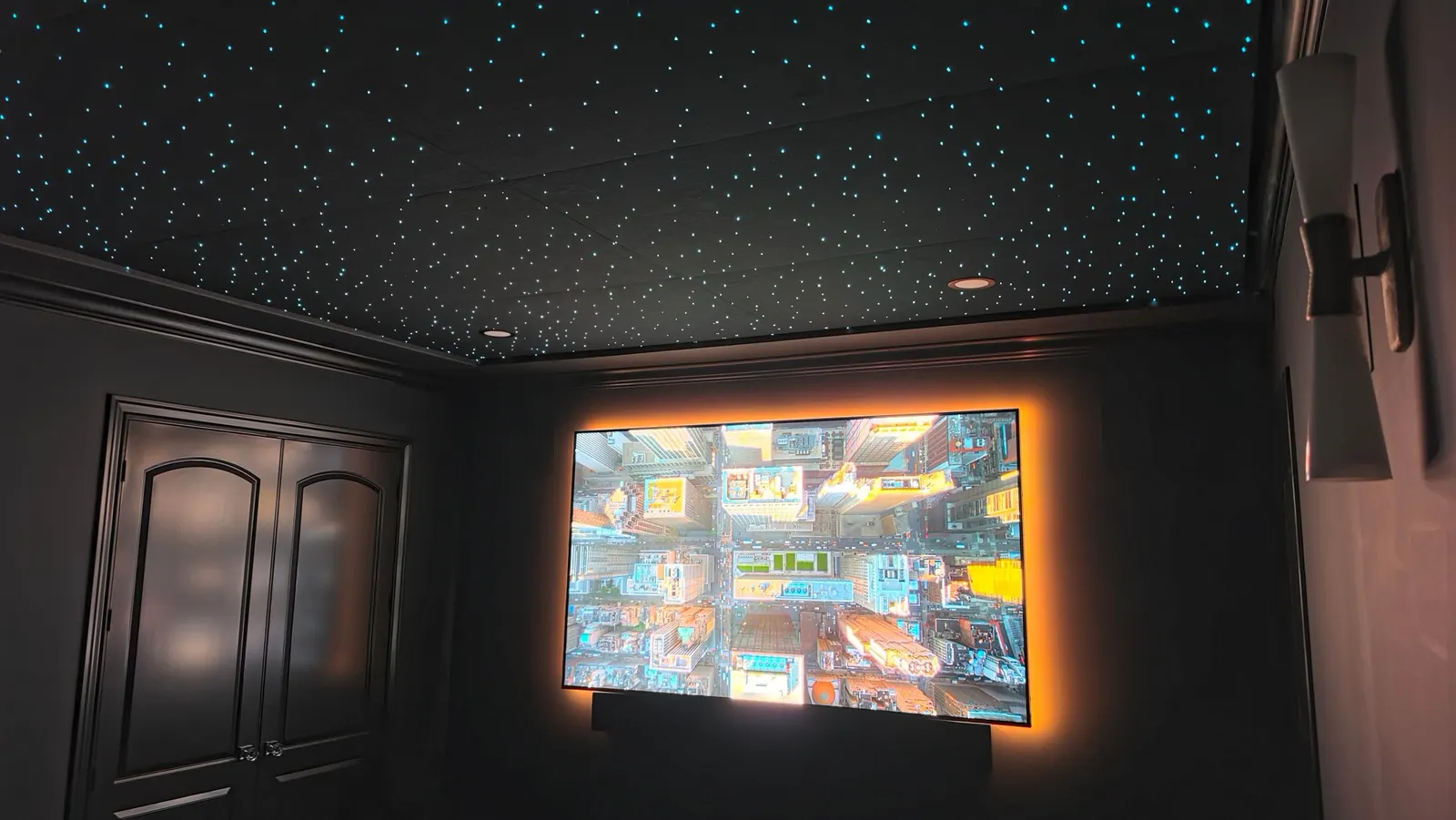
We design and control lighting as its own discipline, with Lutron as our usual recommendation, so the theater's lighting is part of the same system as the rest of the house rather than a separate gadget. (Our lighting design and control work.)
Equipment we trust, chosen for your room.
We specify what fits the room and the budget — not whatever we happen to be trying to move. For picture, that is most often Sony and Samsung. For sound, receivers and processors from Denon, Marantz and Yamaha, with speakers from Focal and Episode, including in-wall and in-ceiling models that disappear into the room.
When it's installed, we set it up properly: speaker levels and distances measured from the seats, the picture adjusted for the room it's in, and every source checked through the one remote. Equipment left on its factory settings is the most common reason an expensive room sounds ordinary.
Building new, or working with the room you have.
New construction. This is where a theater is cheapest to do well. At the framing stage the wire goes anywhere, speaker locations can be framed for, the equipment closet gets power and ventilation, and conduit to the projector location costs almost nothing. After drywall, every one of those is a compromise or a repair. If you're building, talk to us before the walls close. (How we work with builders.)
Existing homes. Most of our theater and media-room work is in houses that are already finished. We get wire where it needs to go with as little disturbance as the house allows, and we're straight with you about where a wall or ceiling will need to be opened and patched, before you commit — not after.
The small jobs too. A television mounted level with the wires hidden, a soundbar that genuinely improves on the TV, a streaming setup that replaces a cable bill. Not every project is a theater, and we're glad to do the simple ones well.
Home Theater Evolutions is now Elegant Automation.
If you knew us as Home Theater Evolutions, you're in the right place. It is one of four established Houston technology companies — along with Integrated System Design Texas, Creative Lighting & Automation and Halcyon Technologies — that now work as one team under the Elegant Automation name. Same people, same phone being answered, and systems we installed under the old names are systems we still look after. (About us.)
We work across Greater Houston: Memorial, Spring Branch, River Oaks and Bellaire; north through Spring, Tomball and The Woodlands to Conroe; and out to Katy, Sugar Land and Kingwood.
Support that doesn't disappear.
A theater is something you live with for years. Streaming services change their apps, a new console arrives, a television gets replaced. We're a call or text away for service and changes, and because the programming is ours, many adjustments can be made remotely instead of waiting on a truck.
An honest answer about price.
We don't post prices, because a number quoted without seeing the room will burn you. A media room around a television and a dedicated theater with a projector are very different projects, and two theaters the same size diverge as soon as the work begins — what's already wired, what's behind the walls, how the room is finished, how dark it can be made. Anyone quoting a "starting at" figure before seeing your room is guessing.
So we do it the honest way. We look at the space, learn how you want to use it, and give you a clear proposal — the equipment, the plan, and the price for your room. New-project consultations are always free, and you'll know exactly what you're getting before any work begins.
Let's look at the room.
Building new, finishing a bonus room, or tired of four remotes in the family room — tell us about the space and how you want to use it.